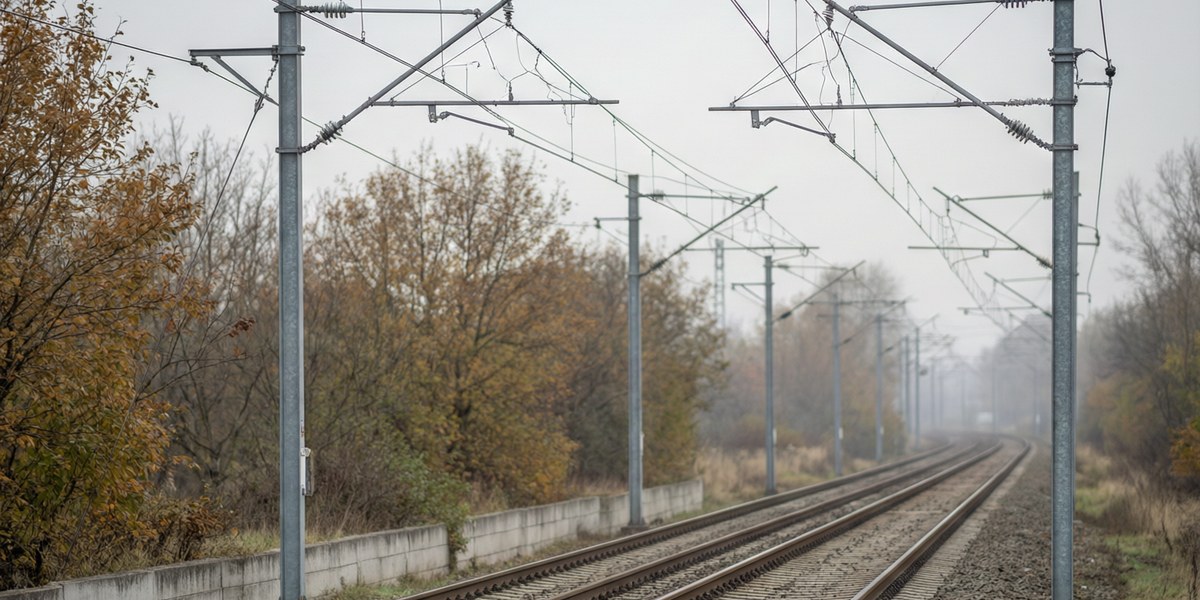
Where the manual approach breaks down
- A track possession is scheduled in weeks and spent in hours.
- Mast-head hardware is read with binoculars from the ballast.
- Vegetation encroachment is confirmed only after a feeder trips.
- The same corridor is walked twice a year by two different crews.
How the unmanned workflow runs
Fly the corridor at wire height
A fixed-wing VTOL follows the mast line above the track at a stand-off distance, so every span between two masts is imaged from the same angle.
Read the hardware, not the silhouette
Zoom and thermal channels resolve insulator shells, clip damage and a hot joint that cannot be seen from the ground.
Hold the link down a straight line
A long-range video and data link carries the feed along a corridor that can run for kilometres without an obstruction.
One operator, one screen
The route is flown from a handheld ground station that shows video, telemetry and mark points together.
Frequently Asked Questions
Do we need a track possession to fly?
Flying is usually planned alongside the line from outside the four-metre zone, so it does not itself occupy the track. Local rules still govern how close you may work to live equipment, and that is decided with the infrastructure manager, not by us.
Can one flight cover both the wire and the track?
Yes. The same pass gives wire geometry from above and the rail head, ballast shoulder and slab edge from the same frame, which is why the two inspections are often merged.
What happens in wind or at night?
Flights are planned for the calm part of the day; the thermal channel is more useful after dark, but the aircraft is not flown outside its stated wind and visibility limits.