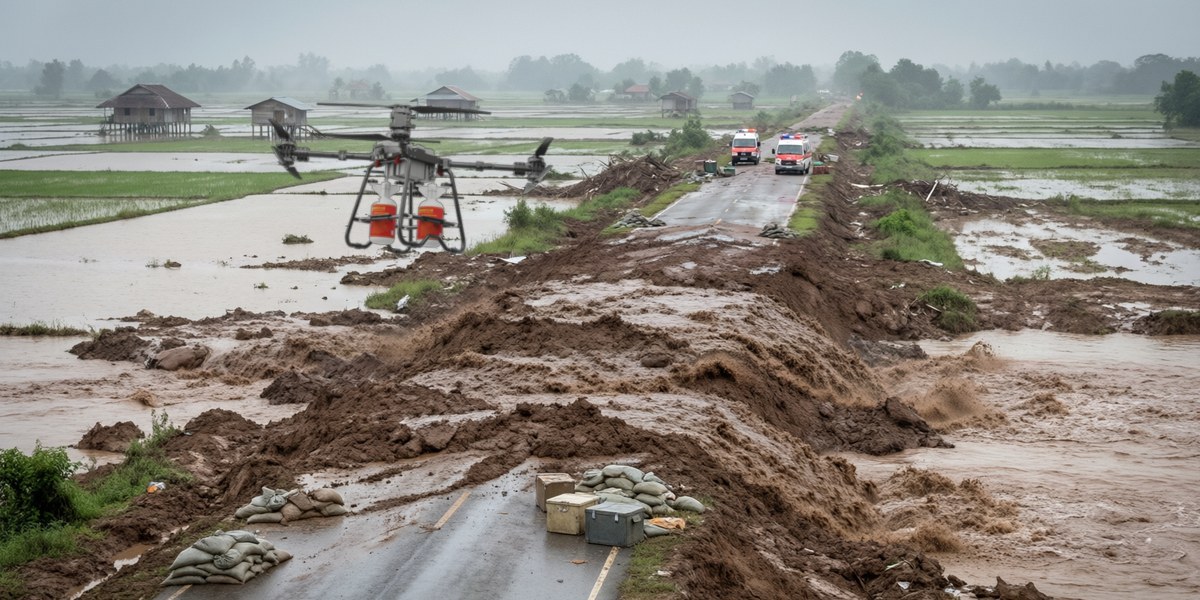
Where the manual approach breaks down
- When access is the constraint, the road — not the stock — is the limiting factor.
- What the scene asks for is small, heavy and urgent, and it is never the pallet that is easy to move.
- The crews who could carry it in are the crews the incident needs elsewhere.
- Suppression and resupply are usually two aircraft on two separate taskings.
How the unmanned workflow runs
Lift from where the vehicles stop
The AT-G190 is a hybrid VTOL with two belly-mounted payload stations, so blood, medicine and a radio battery travel in one sortie without a staging airfield.
Move the single heavy item
When one object is what the scene is waiting on, the AT-MTR150 carries a 150 kg rated load to the point of need and returns after release.
Carry suppression on the same flight
The AT-MFF120 and AT-MFF150 are firefighting aircraft in the 120 kg and 150 kg payload classes, so an extinguishing charge can travel with the resupply instead of behind it.
Specify the control station
The reference set pairs these aircraft with the G30 handheld ground station, so the control and video workflow can be specified from one station rather than assumed.
Frequently Asked Questions
Can it release payload and keep flying?
Yes. The load is released at the point of need and the aircraft returns; the two belly stations on the AT-G190 let a mixed load fly as one sortie.
Is the firefighting variant a different aircraft?
The AT-MFF120 and AT-MFF150 are listed as firefighting aircraft with 120 kg and 150 kg payload classes. Confirm the suppression system and supply scope for the configuration; a large payload alone does not confirm a delivery system.
Does this replace ground crews?
No. It moves what a ground crew cannot reach when access is constrained, so the crew can arrive with the requested items already at the site.