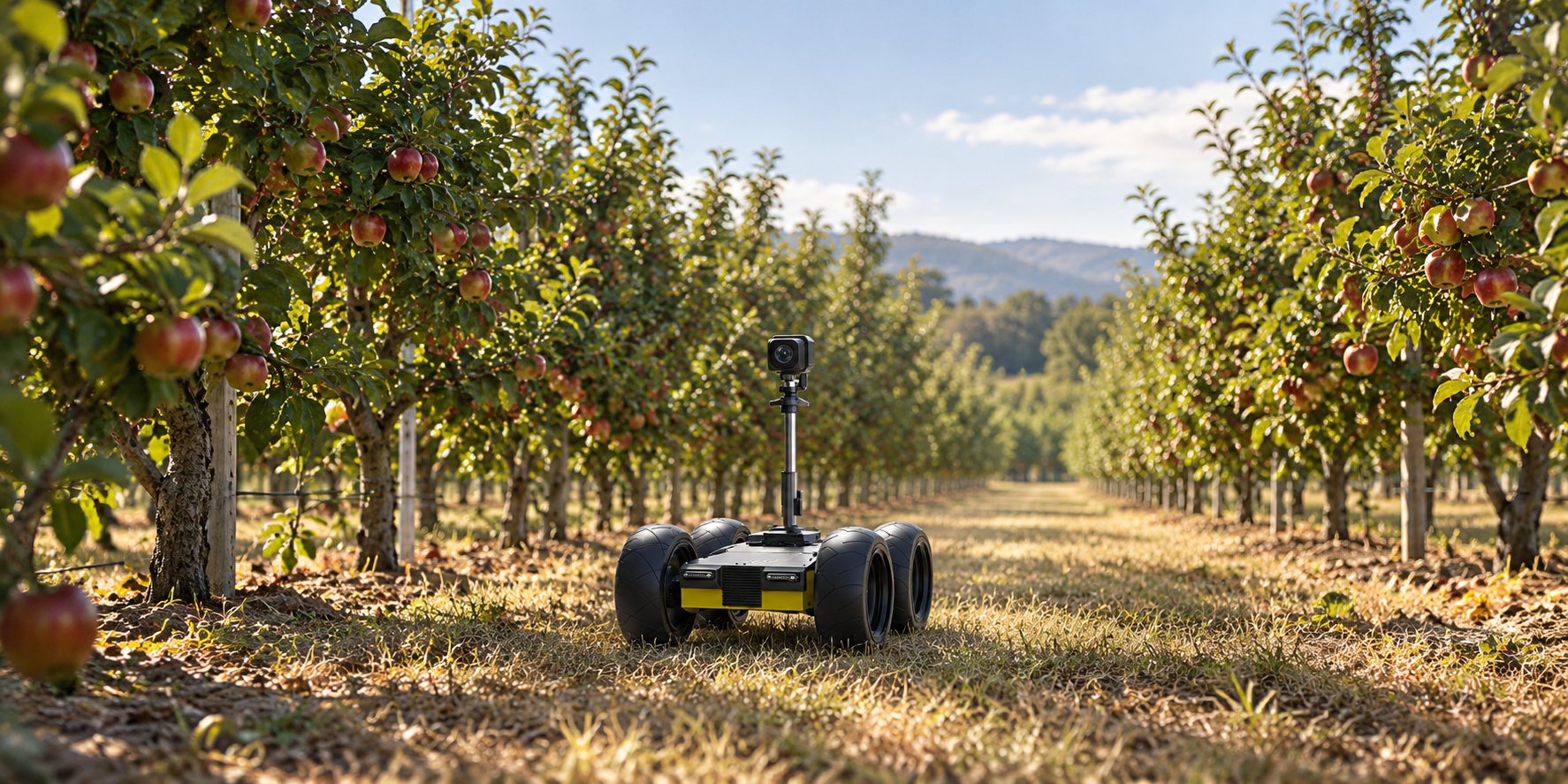
Who this application is for
Orchard operators, agricultural service companies, crop-monitoring integrators and civil research teams.
What to solve first
- Low branches, irrigation pipes and row ends can restrict clearance and turning space.
- Changing ground conditions affect mobility and camera stability.
- A camera image alone does not provide validated crop diagnosis, yield estimation or a treatment decision.
How to plan the workflow
Measure the working row
Record the narrowest gap, branches at camera height, row-end turning space, irrigation lines and access thresholds. Include the width of any added mast or bracket.
Choose the observation task
Define visual tree and irrigation checks, the image viewpoint and whether recording or live viewing is required. Choose optics against that task, not a generic maximum range.
Compare carrier options
Review AT-W25, AT-T20 and AT-W100 against the measured route and total mounted load. Check their actual dimensions and specifications on the product pages.
Validate recording and control
Confirm the receiver-to-VCU interface, camera video output, display/decoder, mounting and power budget. Position antennas and test the link under orchard conditions.
Request the project configuration
Send orchard row photographs, clearance dimensions, camera requirement, complete payload, daily workflow, quantity and destination. Ask separately about any software or sensor integration.
Equipment scope and operating limits
Spraying tanks, pumps, pesticide application, robotic harvesting, automatic disease identification and autonomous row navigation are not included. Do not confuse orchard inspection with the site's existing agricultural spraying or mowing products.
Send these details for a quotation
- Minimum row width and branch clearance
- Surface and irrigation-pipe obstacles
- Camera target, viewpoint and recording need
- Mounted payload and desired control workflow
- Quantity, destination and project timing
Frequently asked questions
Is this an orchard spraying robot?
No. These are inspection and monitoring reference selections. A spraying system, chemical handling equipment and pesticide application are not included.
Can it diagnose disease or estimate yield automatically?
No such performance is established by these catalog products. An imaging or AI analysis project needs separately specified software, data and validation.
How do we check whether it fits our rows?
Measure the narrowest usable width, branches, row-end turning space and obstacles, including the added sensor mounting. Compare those measurements with the complete configured vehicle.
Are cameras and links included in the chassis price?
No. The standard chassis package and separately selected accessories have different quotation scopes. Confirm each item's configuration, price tier, mounting and integration before ordering.