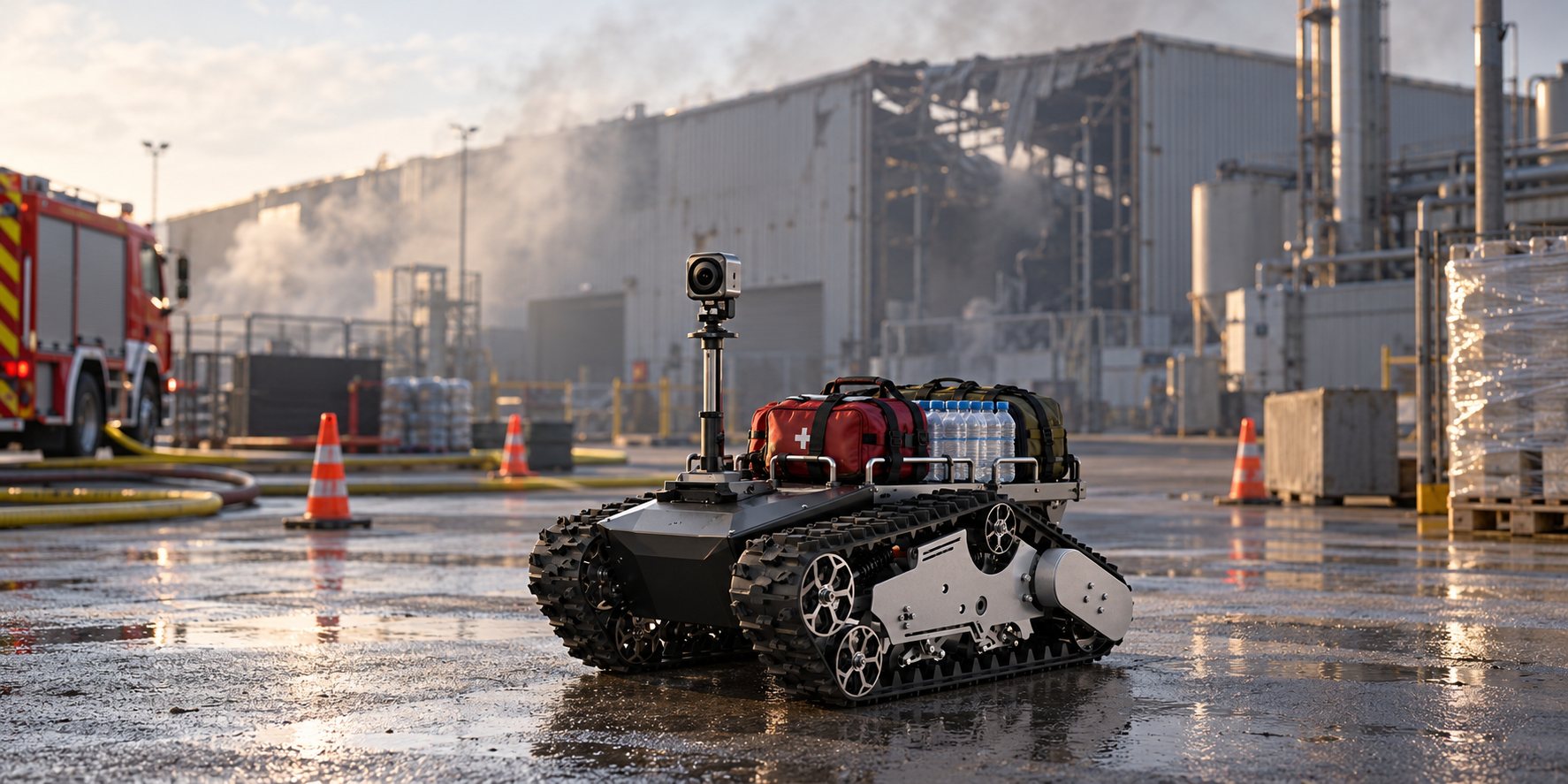
Who this application is for
Civil emergency-response integrators, rescue-equipment suppliers and public-sector procurement teams.
What to solve first
- Responders need observations and supplies without creating an additional uncontrolled vehicle hazard.
- Heat, smoke, liquids and potentially explosive atmospheres require documented equipment suitability, not a generic IP rating.
- Video loss, control loss and delayed stopping must be addressed in the response plan.
How to plan the workflow
Define the permitted operating area
List temperature, smoke, contamination, water and atmospheric hazards. Do not send an ordinary chassis into a fire, explosive atmosphere or unsafe structure.
Choose the observation requirement
Select daylight recording, thermal observation or multi-sensor monitoring. Specify the target and recording workflow; a thermal image is not an automatic fire-safety decision.
Compare the chassis and mounted load
Compare AT-T65, AT-T200 and AT-T125 as tracked mounting platforms. Include camera mast, batteries, communications hardware and supplies within the complete payload.
Engineer loss-of-link and recovery
Specify emergency stop, controlled shutdown, operator visibility, communication loss behavior and recovery arrangements. Confirm each with the actual VCU and receiver.
Request a response-specific configuration
Provide the civil task, environmental limits, route, camera need, control arrangement, quantity and destination. Ask for the exact evidence required by your procurement process.
Equipment scope and operating limits
No heat resistance, explosion-proof approval, smoke penetration, gas detection, firefighting cannon, water pump or casualty transport capability is established by these catalog selections. Cameras do not prove safe entry. Operation is subject to the responsible responder's assessment and applicable requirements.
Send these details for a quotation
- Observation or supply-delivery task
- Permitted environmental conditions
- Thermal or daylight camera requirement
- Emergency-stop and loss-of-link requirements
- Quantity, civil end use and destination
Frequently asked questions
Is this a certified firefighting robot?
No. These catalog chassis have not been established as heat-resistant or explosion-proof firefighting robots. These examples are for a separately assessed support project, not entry into hazardous areas.
Does a thermal camera make the platform fire-safe?
No. Thermal observation does not establish chassis heat resistance, atmospheric safety, operating authorization or suitability for a specific emergency.
Is a water cannon or extinguisher included?
No. No suppression equipment or suppression performance is included or claimed. Such a system would require a separately documented design and approval.
Can we request a civil response configuration?
Yes. Send the observation or transport task, permitted environment, operating route, safety requirements and destination. The exact scope and interfaces are confirmed before quotation.